Creative resilience is your most important resource during times of crisis, change & transition

Cycles of Creation and Managing Transitions
We live in a world of constant change. Nature is an example of continuous birth, growth, death, and renewal. Understanding the cycles of creation helps us thrive in change rather than fear it. While transitions can be painful, they are a source of creativity, growth, and transformation.
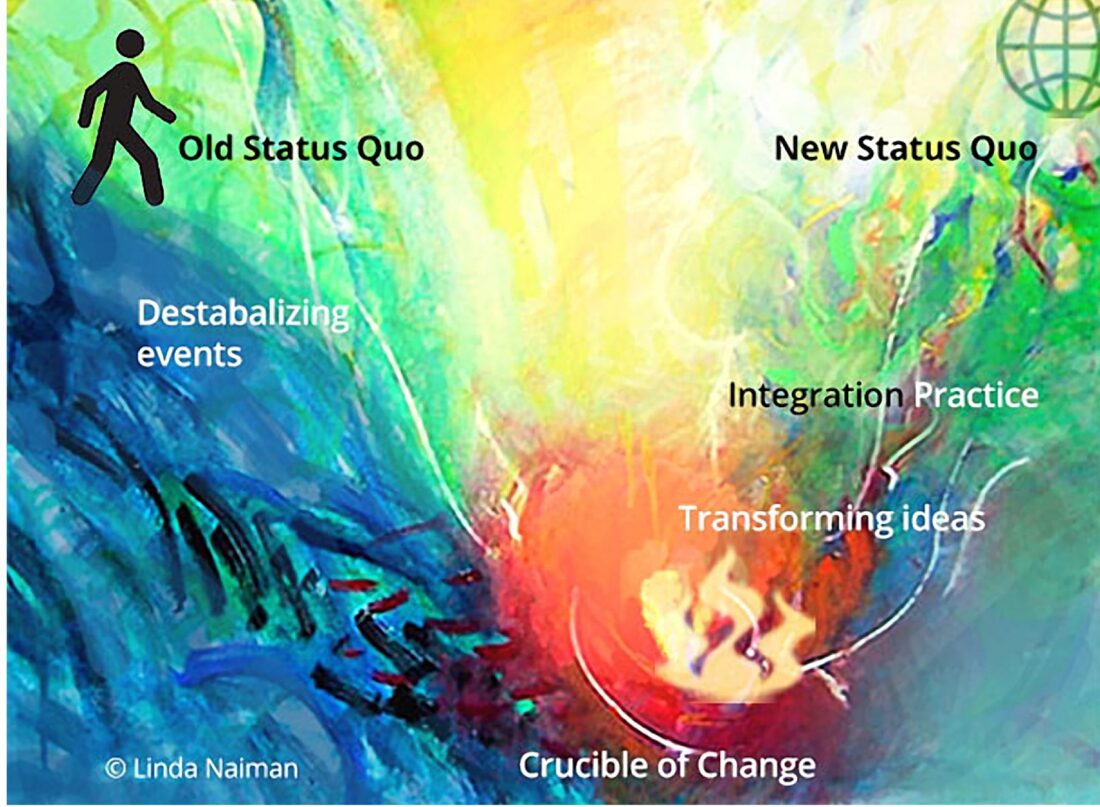
Turbulent times are forcing us to let go of old paradigms and adopt new ways of thinking, being, and acting. Whether it’s launching a new business, scaling a venture, or navigating a personal transition, we are in the midst of powerful shifts that can either overwhelm us or present opportunities for growth.
I’ve long been fascinated by the relationship between creativity and resilience—especially in times of transition. As William Bridges noted, transitions are not just about change but about the psychological process of letting go of the old and embracing the new. It is in this in-between space, this liminal zone, where true transformation happens. Joseph Campbell’s hero’s journey is a metaphor for this, where the hero leaves the familiar, ventures into the unknown, faces trials, and returns transformed.
I’ve experienced this cycle many times in my own life and work. Creative resilience—our ability to adapt, thrive, and innovate in the face of change—has been essential for me and the people I work with.
What transitions have helped you discover new forms of adaptability and creativity?
To be creatively resilient is to reimagine our circumstances and shift our perspective to discover new possibilities.
As Rebecca Solnit so eloquently said,
“Inside the word ’emergency’ is ’emerge’; from an emergency, new things come forth. The old certainties are crumbling fast, but danger and possibility are sisters.”
As David Korten observed, “We can create a world that works for everyone or face a future that no longer works for anyone.” What does this mean? For me, it means not getting sucked into the turmoil and disruption of fear, chaos and crisis, but taking a deep dive below surface agitation.
Physicist David Bohm put it this way,
“At some point deep within the implicate order, thought and language fail us and only sacred silence can reveal the truth. That silence is the language of the whole, the universe expressing itself through us in a life of integrity rather than fragmentation.”
These strategies will help you thrive during times of transition
1. Develop a sense of optimism

“Resilient people and companies face reality with staunchness, make meaning of hardship instead of crying out in despair, and improvise solutions from thin air. Others do not.”
— Diane Coutu
This is not only a time of tremendous chaos, ambiguity, uncertainty, and confusion, it’s also fertile ground for creativity. There are no paths to the future, so we must create them. We have an opportunity. to build a better future for people and the planet.
True optimism, for me, is about maintaining hope while fully engaging with the reality of the situation. This includes facing the hard truths around issues like climate change, inequality, and societal upheaval.
Sustainable optimism doesn’t shy away from difficulty; instead, it helps us envision better futures and work toward them. It’s a delicate balance between being realistic and hopeful—between acknowledging what is and daring to dream of what could be.
Martin Seligman, a pioneer in the positive psychology field, says,
“Optimistic people tend to interpret troubles as transient, controllable and specific….in other words, … surmountable, temporary. Pessimists believe troubles last forever, undermine everything they do and are uncontrollable… troubles are pervasive, permanent and personal.”
Optimism is both a natural trait and a learned skill. Resilient people face difficult situations realistically yet find ways to be optimistic. Studies indicate optimists live longer, have better relationships, and achieve more success in life.
2. Practice Digital-Age Mindfulness

Art © Linda Naiman
“To think in terms of either pessimism or optimism oversimplifies the truth. The problem is to see reality as it is.”
– Thich Nhat Hanh
In today’s digital world, where we’re bombarded with constant information and distractions, staying mindful is more important than ever. I’ve had to develop strategies for maintaining focus in the face of digital overwhelm—whether it’s setting aside time for digital detoxes, creating no-tech zones, or simply being more intentional about how I use technology.
Practicing mindfulness in this context is not about rejecting technology but about navigating it with awareness. It’s about carving out moments of stillness and presence so we can listen more deeply to ourselves and our surroundings.
Mindfulness teaches us to be in control of our mind so that our mind doesn’t control us. Those who learn to be mindful experience less stress and clearer thinking. Meditation and mindfulness can calm the brain’s fight/flight/freeze mechanism, creating space for higher-order thinking and generating creative solutions.
Herbert Benson, a pioneer of scientific research on meditation, extolls its benefits on the human body — reduced blood pressure, heart rate, and brain activity.
3. Find meaning and purpose even in terrible times
“In some ways suffering ceases to be suffering at the moment it finds a meaning.”
— Viktor Frankl
Viktor Frankl’s 1946 book Man’s Search for Meaning offers profound lessons on being resilient in dire situations. Frankl says meaning and purpose is found in every moment of living; life never ceases to have meaning, even in suffering and death.
Frankl wrote,
“We who lived in concentration camps can remember the men who walked through the huts comforting others, giving away their last piece of bread. They may have been few in number, but they offer sufficient proof that everything can be taken from a man but one thing: the last of the human freedoms—to choose one’s attitude in any given set of circumstances, to choose one’s own way.”
This is a point I make with clients who feel powerless: No matter what is going on, you can always choose your attitude, and show leadership, by setting an example for others.
4. Express yourself creatively

“To be successful, we must live from our imaginations, not from our memories.”
—Steven Covey
Creativity is at the heart of resilience. I’ve always believed that creative expression—whether through art, writing, or problem-solving—provides a powerful outlet for processing emotions, making sense of chaos, and generating new ideas.
As AI tools become more integrated into our work, they enhance our creative capabilities but also highlight the importance of human creativity. It’s our unique ability to infuse work with personal meaning, emotional depth, and a nuanced understanding of human experience that makes creativity so vital in this AI-driven age.
When my coaching clients talk about times of transition, I often ask them what they could do to nurture themselves to reduce stress. Creativity frequently comes up, along with getting enough sleep, exercising, and spending time with friends or family.
I myself am guilty of neglecting my personal creativity, although I seem to be writing all the time. I felt a trace of sadness about not having painted for so long, when I read James McMullen’s poetic discourse on how to draw, in the New York Times. He writes, “Drawing is a process of engagement for the artist, a period of both time and struggle that pulls the artist deeply and intensely into his subject and his ideas.” In my view, this is key to becoming resilient. His series of articles Line by Line, is about “rediscovering the lost skill and singular pleasure of drawing. I also see this as a metaphor for everyone.
Is there a lost skill, a singular pleasure you need to reclaim?
5. Master Improvisation
“My whole life has been one big improvisation.”
—Clint Eastwood
Resilient people are masters of innovation and resourcefulness. They have the capacity to improvise and create bricolage—creative problem-solving using a variety of materials that happen to be available.
The Apollo 13 mission is a dramatic example of improvisation. When an oxygen tank exploded on the spacecraft, scrubbing the lunar landing, the Mission Control in Houston improvised a method to reduce carbon dioxide levels, using objects available on the spaceship, so that the astronauts could fix the problem and safely return to Earth.
As a coach and innovator, I often have to pivot in the moment—adjusting to new information or unforeseen challenges. This flexibility allows for more dynamic, creative problem-solving and often leads to breakthroughs that wouldn’t have been possible with a rigid approach.
How might you improvise at home or at work? What resources do you have available to you, to utilize in new ways?
6. Build Meaningful Connections

“When we focus on ourselves, our world contracts as our problems and preoccupations loom large. But when we focus on others, our world expands. Our own problems drift to the periphery of the mind and so seem smaller, and we increase our capacity for connection – or compassionate action.”
—Daniel Goleman
Healthy relationships are at the heart of creativity and collaboration. Appreciating others, engaging in purposeful conversations, and resolving conflicts are essential ingredients for collaboration.
Communication is about making a connection, and a connection won’t happen unless we tap into our abilities to listen, to empathize, to really be present with others, and to talk about what matters. Find ways for people to get to know each other not just as professionals, but also as human beings, to build trust and provide occasions for informal social interaction.
7. Practice Gratitude

“Be thankful for what you have; you’ll end up having more. If you concentrate on what you don’t have, you will never, ever have enough.”
—Oprah Winfrey
According to the Greater Good Science Center at UC Berkeley “The experience of gratitude encourages us to appreciate what is good in our lives and compels us to pay this goodness forward. People with more grateful dispositions report being happier and more satisfied with their lives. Gratitude also functions as social glue that nurtures the formation of new friendships, enriches our existing relationships, and underlies the very foundation of human society.”
There is also a surprising connection between gratitude and creativity.
8. Creating a path to the future
“Small groups exploring common questions and learning that others are doing the same, has always been the locus for large scale transformative change.”
—Juanita Brown
It helps to connect with groups who want to make a positive change in the world, whose values you share, and who are willing to embrace diverse perspectives to meaningful insights.
One way to do this is to create a community of practice so that you can experiment and learn as a group. Communities of practice (CoPs) as defined by Etienne and Beverly Wenger-Trayner, are “groups of people who share a concern, a set of problems, or a passion about a topic, and who deepen their knowledge and expertise in this area by interacting on an ongoing basis.”
When we engage in communities of practice we are tapping into the collective wisdom of the group. CoPs are vital for navigating transitions because they offer a space for experimentation, feedback, and shared learning.The great thing about CoPs is that you can free yourself from the tyranny of perfectionism and allow yourself to explore and experiment.
The Path Forward: Thriving in a Changing World

Art by Linda Naiman © 2016
As we continue to navigate this rapidly changing world, the pace of transformation can feel overwhelming. Yet it’s in these moments that creative resilience becomes more essential than ever. Mental fitness—strengthening the connection we have to our inner Sage—plays a crucial role in maintaining resilience both personally and professionally.
The path forward, I believe, is through the heart. It requires us to embrace both individual and collective resilience, to think both locally and globally, and to take both immediate action and long-term vision. It’s about creating futures that work not just for all people, but for all life on Earth.
Updated Nov. 5, 2025
Watch a short intro to Creative Resilience. Click below.