George Land’s Creativity Test
In 1968, George Land conducted a research study to test the creativity of 1,600 children ranging in ages from three-to-five years old who were enrolled in a Head Start program. This was the same creativity test he devised for NASA to help select innovative engineers and scientists. The assessment worked so well he decided to try it on children. He re-tested the same children at 10 years of age, and again at 15 years of age. The results were astounding.
Test results amongst 5 year olds: 98%
Test results amongst 10 year olds: 30%
Test results amongst 15 year olds: 12%
Same test given to 280,000 adults: 2%
“What we have concluded,” wrote Land, “is that non-creative behavior is learned.”
George Land, Ph.D. (1932 – 2016) was an author, a general systems scientist and Fellow of the World Business Academy.
References:
George Land and Beth Jarman, Breaking Point and Beyond. San Francisco: HarperBusiness, 1993
James, M, Higgins, Escape from the Maze: 9 Steps to Personal Creativity New Management Publishing Company, 1996.
Watch George Land discuss his creativity study at the 6:08 mark during his Tedx talk:
(if you don’t see the video here, click on this Youtube link
Why aren’t adults as creative as children?
For most, creativity has been buried by rules and regulations. Our educational system was designed during the Industrial Revolution over 200 years ago, to train us to be good workers and follow instructions.
Can Creativity be Taught?
Yes, creativity skills can be learned. Not from sitting in a lecture, but by learning and applying creative thinking processes. Here is an abstract from a study on The Effectiveness of Creativity Training:
Over the course of the last half century, numerous training programs intended to develop creativity capacities have been proposed. In this study, a quantitative meta-analysis of program evaluation efforts was conducted.
Based on 70 prior studies, it was found that well-designed creativity training programs typically induce gains in performance with these effects generalizing across criteria, settings, and target populations. Moreover, these effects held when internal validity considerations were taken into account.
An examination of the factors contributing to the relative effectiveness of these training programs indicated that more successful programs were likely to focus on the development of cognitive skills and the heuristics involved in skill application, using realistic exercises appropriate to the domain at hand.
The implications of these observations for the development of creativity through educational and training interventions are discussed along with directions for future research.
(Source: Ginamarie Scott, Lyle E. Leritz, and Michael D. Mumford, Creativity Research Journal, 2004, Vol. 16, No. 4, 361–388)
Whole Brain Creativity Workshops
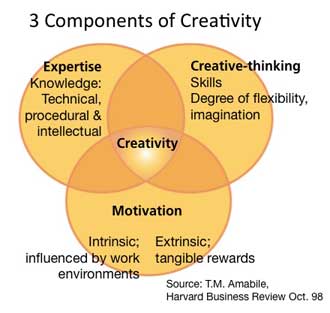
Creativity is a skill that can be developed and a process that can be managed. Creativity begins with a foundation of knowledge, learning a discipline, and mastering a way of thinking. We learn to be creative by experimenting, exploring, questioning assumptions, using imagination and synthesizing information.
Teaching Creativity at IBM
From a post by August Turak on Forbes.com on the timeless wisdom of Louis R. Mobley
Every great leader is a creative leader. If creativity can be taught how is it done?
In 1956, Louis R. Mobley realized that IBM’s success depended on teaching executives to think creatively rather than teaching them how to read financial reports. As a result, the IBM Executive School was built around these six insights:
First, traditional teaching methodologies like reading, lecturing, testing, and memorization are worse than useless. They are actually the counter-productive way in which boxes get built. Most education focuses on providing answers in a linear step by step way. Mobley realized that asking radically different questions in a non-linear way is the key to creativity.
Mobley’s second discovery is that becoming creative is an unlearning rather than a learning process. [Did he know about George Land’s study above?] The goal of the IBM Executive School was not to add more assumptions but to upend existing assumptions. Designed as a “mind-blowing experience,” IBM executives were pummeled out of their comfort zone often in embarrassing, frustrating, even infuriating ways. Providing a humbling experience for hot shot executives with egos to match had its risks, but Mobley ran those risks to get that “Wow, I never thought of it that way before!” reaction that is the birth pang of creativity.
Third, Mobley realized that we don’t learn to be creative. We must become creative people. A Marine recruit doesn’t learn to be a Marine by reading a manual. He becomes a Marine by undergoing the rigors of boot camp. Like a caterpillar becoming a butterfly, he is transformed into a Marine. Mobley’s Executive School was a twelve-week experiential boot camp. Classes, lectures, and books were exchanged for riddles, simulations, and games. Like psychologists, Mobley and his staff were always dreaming up experiments where the “obvious” answer was never adequate.
Mobley’s fourth insight is that the fastest way to become creative is to hang around with creative people –regardless of how stupid they make us feel. An early experiment in controlled chaos, The IBM Executive School was an unsystematic, unstructured environment where most of the benefits accrued through peer to peer interaction much of it informal and off-line.
Fifth, Mobley discovered that creativity is highly correlated with self-knowledge. It is impossible to overcome biases if we don’t know they are there, and Mobley’s school was designed to be one big mirror.
Finally and perhaps most importantly, Mobley gave his students permission to be wrong. Every great idea grows from the potting soil of hundreds of bad ones, and the single biggest reason why most of us never live up to our creative potential is from fear of making a fool out of ourselves. For Mobley, there were no bad ideas or wrong ideas only building blocks for even better ideas.
—Read the full article by August Turak at Forbes.com
Mobley’s insights ring true for me, although I’d avoid his jarring approaches to unlearning creativity. There are ways to unlearn creativity that don’t involve putting subjects through a psychological boot camp. Learning to be creative is akin to learning a sport. It requires practice to develop the right muscles and a supportive environment in which to flourish.
Creativity tips for leaders
Fuel Curiosity:
- Challenge the status quo: Ask open-ended questions that trigger critical thinking and encourage “what if” scenarios.
- Share intriguing tidbits: Inject interesting facts, articles, or multimedia related to your industry or beyond to spark inspiration.
- Organize field trips or talks: Immerse your team in new experiences with industry experts, museums, or workshops.
Ignite Inspiration:
- Curate a “curiosity corner”: Create a physical or virtual space showcasing diverse inspiration sources like art, music, science articles, or historical anecdotes.
- Encourage cross-pollination: Organize knowledge-sharing sessions between departments to expose everyone to different perspectives and approaches.
- Break down silos: Foster collaboration with external partners or experts to bring in fresh ideas and viewpoints.
Sharpen Your Tools:
- Brainstorm like champions: Run workshops on effective brainstorming techniques like SCAMPER or mind mapping to generate diverse solutions.
- Reframe the problem: Equip your team with problem-solving frameworks like Design Thinking to tackle challenges from different angles.
- Embrace experimentation: Encourage calculated risks and trying new tools or approaches, celebrating learning from both successes and failures.
Boost Confidence:
- Praise effort and progress: Highlight not just results, but the innovative thinking and courage it took to get there.
- Create a safe space for ideas: Foster an environment where sharing even unconventional ideas is encouraged and feedback is constructive.
- Celebrate milestones: Recognize and reward even small steps towards achieving creative goals, keeping motivation high.
Remember, nurturing creativity is not a one-time event, but an ongoing process. By incorporating these tips and fostering a culture of open-mindedness and experimentation, you can empower your team to unlock their creative potential and drive your organization forward.
Updated Feb 16, 2024