Adobe Uncovers Global Creativity Gap
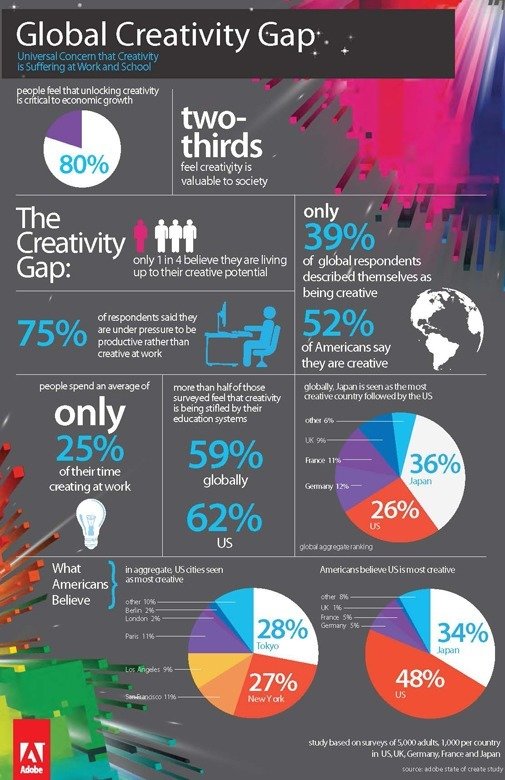
Adobe has just published a global study on creativity. The research shows 8 in 10 people feel that unlocking creativity is critical to economic growth and nearly two-thirds of respondents feel creativity is valuable to society, yet a striking minority – only 1 in 4 people – believe they are living up to their own creative potential.
Interviews of 5,000 adults across the United States, United Kingdom, Germany, France and Japan expose surprising attitudes and beliefs about creativity, providing new insights into the role of creativity in business, education and society overall.
Highlights from the Adobe Study:
Universal Concern that Creativity is Suffering at Work and School
Workplace Creativity Gap
The study reveals a workplace creativity gap, where 75% of respondents said they are under growing pressure to be productive rather than creative, despite the fact that they are increasingly expected to think creatively on the job. Across all of the countries surveyed, people said they spend only 25% of their time at work creating. Lack of time is seen as the biggest barrier to creativity (47% globally, 52% in United States).
Education Concerns
More than half of those surveyed feel that creativity is being stifled by their education systems, and many believe creativity is taken for granted (52% globally, 70% in the United States).
“One of the myths of creativity is that very few people are really creative,” said Sir Ken Robinson, Ph.D., an internationally recognized leader in the development of education, creativity and innovation. “The truth is that everyone has great capacities but not everyone develops them. One of the problems is that too often our educational systems don’t enable students to develop their natural creative powers. Instead, they promote uniformity and standardization. The result is that we’re draining people of their creative possibilities and, as this study reveals, producing a workforce that’s conditioned to prioritize conformity over creativity.”
See also: Creativity and Education: Why it Matters
Creativity Rating: Japan Ranked Most Creative
The study sheds light on different cultural attitudes toward creativity. Japan ranked highest in the global tally as the most creative country while, conversely, Japanese citizens largely do not see themselves as creative. Globally, Tokyo ranked as the most creative city – except among Japanese – with New York ranking second. Outside of Japan, national pride in each country is evident, with residents of the United Kingdom, Germany and France ranking their own countries and cities next in line after Japan.
The United States ranked globally as the second most creative nation among the countries surveyed, except in the eyes of Americans, who see themselves as the most creative. Yet Americans also expressed the greatest sense of urgency and concern that they are not living up to their creative potential (United States at 82%, vs. the lowest level of concern in Germany at 64%).
Generational and gender differences are marginal, reinforcing the idea that everyone has the potential to create. Women ranked only slightly higher than men when asked if they self-identified as creative and whether they were tapping their own creative potential.
Four in 10 people believe that they do not have the tools or access to tools to create. Creative tools are perceived as the biggest driver to increase creativity (65% globally, 76% in the United States), and technology is recognized for its ability to help individuals overcome creative limitations (58% globally, 60% in the United States) and provide inspiration (53% globally, 62% in the United States).
See also: Adobe Study a Wake-up Call to Invest in Creativity in Business and Education
About the Adobe State of Create Study
The study was produced by research firm StrategyOne and conducted as an online survey among a total of 5,000 adults, 18 years or older, 1,000 each in the United States, United Kingdom, Germany, France and Japan. Interviewing took place from March 30 to April 9. The data set for each country is nationally representative of the population of that country.
What will you do to foster creativity at work?