
Play: How It Shapes the Brain, Opens the Imagination and Invigorates the Soul
Think about your creative intelligence during times of stress. What is the quality of your thinking, compared to when you are in flow states (characterized by energized focus, absorption, and being fully engaged)? I’m willing to bet your flow states produce superior results than fear-based solutions.
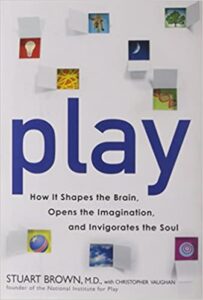
Stuart Brown and Christopher Vaughan in their book Play: How It Shapes the Brain, Opens the Imagination and Invigorates the Soul (Amazon), say, “If we don’t take time to play, we face a joyless life of rigidity, lacking in creativity. The opposite of play isn’t work, but depression. If we’re going to adapt to changing economic and personal circumstances the way that nature armed us to do, then we have to find ourselves having some play time virtually every day.”
Brown says that employees who have engaged in play throughout their lives outside of work and bring that emotion to the office are able to do well at work-related tasks that at first might seem to have no connection at all to play.
A look at the serious side of play:
Cal Tech’s Jet Propulsion Laboratory (JPL) has been the United States’ premier aerospace research facility for more than seven decades. The scientists and engineers at JPL have designed and managed major components of every manned and unmanned mission of our time, and have been completely responsible for dreaming up, building, and operating complex projects like the robot vehicles that landed on Mars and explored the planet’s surface for years. You might say that JPL invented the Space Age. No matter how big and ambitious the goal, the researchers could always be relied on to say, “We can do that.”
But in the late nineties, the lab’s management was saying, “JPL, we have a problem.” As the lab neared the new century, the group of engineers and scientists who had come on board in the 1960s, those who put men on the moon and built robotic probes to explore the solar system, were retiring in large numbers. And JPL was having a hard time replacing them. Even though JPL hired the top graduates from top engineering schools like MIT, Stanford, and even Cal Tech itself, the new hires were often missing something. They were not very good at certain types of problem solving that are critical to the job. The experienced managers found that the newly minted engineers might excel at grappling with theoretical, mathematical problems at the frontiers of engineering, but they didn’t do well with the practical difficulties of taking a complex project from theory to practice. Unlike their elders, the young engineers couldn’t spot the key flaw in one of the complex systems they were working on, toss the problem around, break it down, pick it apart, tease out its critical elements, and rearrange them in innovative ways that led to a solution.
Why was JPL hiring the wrong sorts of engineers? The people JPL brought aboard had earned the highest grades at the best schools, but academic excellence was obviously not the most important measure of the graduates’ problem-solving skills. Like good engineers, JPL management analyzed the problem and concluded that when hiring they were looking at the wrong data. Those job candidates good at problem solving and those who were not could be sorted, they believed, if they found the right metrics.
Then the head of JPL found Nate Jones. Jones ran a machine shop that specialized in precision racing and Formula One tires, and he had noticed that many of the new kids coming in to work at the shop were also not able to problem solve. Jones and his wife, who is a teacher, wondered what had changed. After questioning the new kids and the older employees, Jones found that those who had worked and played with their hands as they were growing up were able to “see solutions” that those who hadn’t worked with their hands could not. Jones wrote an article about what he had found, which is how he came to the attention of JPL management.
The JPL managers went back to look at their own retiring engineers and found a similar pattern. They found that in their youth, their older, problem-solving employees had taken apart clocks to see how they worked, or made soapbox derby racers, or built hi-fi stereos, or fixed appliances. The young engineering school graduates who had also done these things, who had played with their hands, were adept at the kinds of problem solving that management sought. Those who hadn’t, generally were not. From that point on, JPL made questions about applicants’ youthful projects and play a standard part of job interviews.
Once people understand what play does for them, they can learn to bring a sense of excitement and adventure back to their lives, make work an extension of their play lives, and engage fully with the world.
I don’t think it is too much to say that play can save your life. It certainly has salvaged mine. Life without play is a grinding, mechanical existence organized around doing the things necessary for survival. Play is the stick that stirs the drink. It is the basis of all art, games, books, sports, movies, fashion, fun, and wonder-in short, the basis of what we think of as civilization. Play is the vital essence of life. It is what makes life lively.
Excerpted with permission from Stuart Brown.
Stuart Brown says there are eight play personalities:
- Joking. Some of the earliest forms of play begin when a parent is foolish with an infant, blowing raspberries or making sounds.
- Moving. This includes athletes but involves anyone who is happiest moving, whether it’s dancing, swimming or walking.
- Exploring. We entered the world exploring it, Brown says. This can be physical or emotional, searching for a new feeling or deepening what is known through music, movement or flirtation.
- Competing. If playing games and keeping score is up your alley, you already know this category. You might have a high score in a video game. You can be on the field or get the same benefits off the field as a fan. Maybe it’s time to consider fielding a fantasy baseball team.
- Directing. These people love to plan parties or vacations, or execute great scenes, whether it’s Oprah Winfrey or Danny Boyle (Slumdog Millionaire).
- Collecting. This could be gathering music or wine or comic books. Everything is fair game. He mentions Jay Leno’s penchant for collecting cars. Some women have their handbags.
- Storytelling. Imagination rules this mode of play. This can be as loony as having an imagined cooking show in your kitchen one night, or sending funny short video clips off to YouTube. Reading and watching movies falls into this category.
- Creating art. Maybe you draw or paint. Maybe you like redecorating a room. Or, Brown says, maybe you just like taking things apart and making them new again.
Source retrieved April 14, 2009: http://www.usatoday.com/news/health/2009-03-23-play-stress_N.htm
Get creative via the arts and play
One of the reasons I use the arts in my work with organizations is because the collective voice of the inner critic quiets down, imagination comes to the fore, and feelings of well-being replace anxiety. Art in this context is a form of play which produces flow states in groups as well as individuals. The atmosphere changes from the staccato of mind chatter to the spaciousness of being present in the here and now. From this foundation, creativity, connection, collaboration and transformation become possible.
See also: