In just six days in Macedonia, I led three workshops, dined like royalty, walked a marathon (well, half of one), and floated the idea of a new Prime Minister!

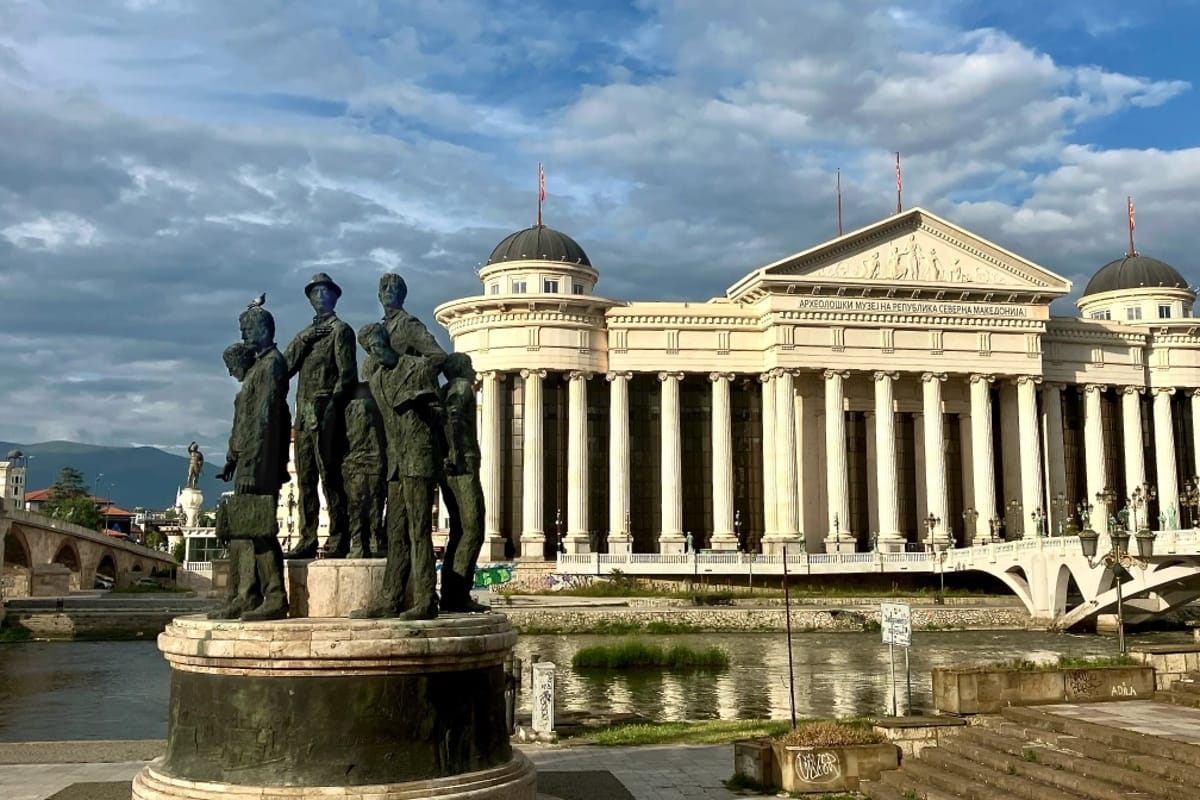
Skopje’s city square
I rarely write about my business travels, but I can’t resist sharing my experience in Skopje, the vibrant capital of Macedonia. I was invited by Elena Mladenovska Jelenkovic, CEO of M6 Educational Centre, to run a two-day workshop on creativity, resilience, and value creation for their Board of Trustees.

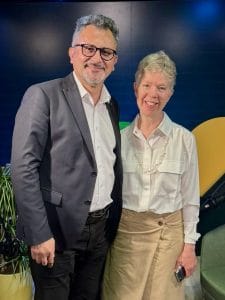
A selfie with Elena Mladenovska Jelenkovic, CEO of M6 Educational Centre
Creativity in Action

A scene from my Creativity and Innovation Workshop at M6
The M6 Educational Centre is a leading institution in the Balkans for lifelong learning and business transformation.
Day one began with a podcast interview at a local television station with Filip Ivanovski. We explored creativity, leadership, and how artistic intelligence can drive innovation in business. (Watch the podcast on Youtube)
Over the next two days, I facilitated an immersive, hands-on learning experience that blended whole-brain creativity, mental fitness, neuroscience, and art. Teams competed to exponentially increase the value of a product or service—unlocking new ways to collaborate, create and deliver value.
Many were surprised to learn that creativity can actually boost speed and productivity. When teams are empowered to think creatively, they solve problems faster, collaborate more effectively, and generate greater value.

Participants at my creativity session at M6
We also explored creative resilience—the ability to stay open, curious, and resourceful under pressure. It’s an essential skill for leaders navigating today’s volatile business landscape.

Participants at my creativity session at M6 on value-creation
A Taste of Macedonian Innovation
After the workshop, a manager from M6’s sister company, Tikveš Winery, asked if I could do a session for their leadership team. I happily said yes.
Founded in 1885, Tikveš is rooted in centuries-old winemaking traditions. Nearly every wine in their portfolio has won international accolades. They continue to innovate while honouring their heritage—and I was thrilled to help them explore creative ways to add value to their brand.
At lunch on my second day, I met Svetozar Janevski, founder of M6 Investment Group and one of Macedonia’s most influential business leaders. He led the acquisition and transformation of Tikveš in 2003, when it was struggling.
By 2008, Tikveš was recognized by the Wine Innovation Forum (Paris) as being among the top 30 innovative wine companies globally.
How Heritage and Tradition Impact Innovation
Svetozar Janevski’s approach—honouring heritage while embracing innovation, and bringing in experts to expand knowledge and know-how (in his case, French winemaking specialists)—offers a powerful model for any business leader, especially those whose companies or cultures are deeply rooted in tradition. It makes your offerings memorable and nearly impossible to replicate.
As I reflect on my conversations at M6 and Tikveš, I see an important distinction between heritage and tradition. Heritage is not to be confused with tradition. Heritage is our inheritance—what we carry forward from the past. Tradition, on the other hand, is how we’ve always done things.
While heritage can inspire innovation and identity, tradition sometimes needs to be reimagined. This is something Europe excels at—honouring the past while evolving with the times.
In some cases, preserving tradition strengthens culture—and in winemaking, it can enhance both the identity and quality of a product.
When paired with innovation, tradition becomes a source of distinction rather than limitation. The key is knowing when to honour, when to evolve, and when to let go.
When paired with innovation, tradition becomes a source of distinction rather than limitation. The key is knowing when to honour, when to evolve, and when to let go.

At Tikveš Winery.
Leadership with Heart
Elena is more than a CEO, she is a natural-born ambassador to her beloved country. She has a keen interest in creating a positive future for the next generation. Elena, along with her team, is committed to helping companies develop leaders who are more productive, happier, and better prepared to shape the future of the Macedonian economy. They also approach their work with ease and grace, creating a calm, stress-free environment.

Alexander the Great statue in Skopje city centre (officially known as warrior on horseback)
Elena showed me around the city center, featuring monumental newly built neo-classical buildings and amazing sculptures, including a giant statue of Alexander the Great. (Though, due to a naming dispute with Greece, Macedonians aren’t officially allowed to call him that. It’s also why the country is officially called NorthMacedonia.)
The urban renewal project, known as Skopje 2014, stirred mixed reactions. While the neoclassical and baroque architecture added grandeur to the city center, some critics felt it clashed with Skopje’s existing character. The sheer number of statues—many of them oversized—sparked debate, and the project’s costs raised questions among locals.
I’ve never seen so many sculptures in an urban setting. The abundance of men on horseback reminded me of the generals in Buenos Aires. Personally, I found the neoclassical buildings impressive at first glance—but I did not know the back story at the time.

Karposh 0n Horseback. Karposh was the leader of a major anti-Ottoman uprising in the Central Balkans during 1689.
Elena also introduced me to Macedonian cuisine in spectacular fashion. To my surprise, the best fine dining in Skopje is at the Marriott Hotel. Elena wanted me to taste everything—and practically ordered the whole menu.
M6 also has its own executive chef and private dining rooms, where we enjoyed Michelin-star-quality meals during the program.

Tikveš Winery private dining room
On day five, Elena took me on a tour of the winery, followed by a three-course lunch in their gorgeous private dining room. This was culinary artistry on par with top European restaurants. Our lunch lasted three hours, not because of slow service, but because we had so much to talk about while savouring their award-winning wines.

Enjoying a Michelin-quality lunch with Elena at Tikveš Winery
At one point Elena leaned over and said to me, “Linda, tell me the truth, what did you think of Macedonia before you came here? I smiled and admitted I didn’t know much, and I did check the Canadian government’s travel advisory first to see if it was safe. (Yes, it is.) I check for travel safety before going to any country I don’t know well.
Beyond the Boardroom
Our lunch ended at 6 pm and we rushed back to Skopje to do a quick change and attend a gala event to celebrate the 15-year anniversary of Macedonia’s airports. There I met the CEO, members of the local business and government communities, and even the honorary Canadian consul general.
It was at this event that I floated the idea that maybe Elena should be Prime Minister. She was surprised at how quickly people responded affirmatively, though alas, it’s not a role she really desires.
The next day, Elena arranged for a company driver and staff member to take me on a day trip through the mountains to Lake Ohrid—one of oldest lakes in the world—and a UNESCO World Heritage Site. (Fun fact: NASA even named one of Titan’s lakes after it.) 365 churches span the lake, so you could visit a different one every day of the year

St. Naum built his monastery around 905. It was reconstructed in the 16th c. Photo: P. Milosevic
We only had time to visit the grounds of the Monastery of Saint Naum, built in 905. The interior is covered with numinous frescoes of saints and biblical scenes that seem to glow in the dim interior.

Saint Naum was an important writer, teacher and missionary.
Saint Naum is buried here and it is said if you lay your head down on his tomb, you can hear his heart beating. Or perhaps it’s the sound of the lake below. Whichever it is, I definitely felt the sacredness of this space.
Day 6
On my final day, Elena picked me up early to join her and M6 teammates Tamara and Blagica for a 10K marathon—a perfect way to cap off the trip

Tamara is to my left, Elena and Blagica to my right.
We walked 5K instead and it was a wonderful opportunity to meet other Macedonians. Everyone is so friendly and welcoming. I felt right at home. We finished around noon and two hours later I was off to Porto to join friends for our walk on the Camino—but that is a story for another time.
Reflections on a Creative Journey
This journey exemplifies the power of arts-based learning and immersive experiences in executive education. It highlights how creative leadership and innovation retreats can foster transformational leadership and cultural intelligence in organizations.
I packed more into six days than I thought possible—and didn’t feel exhausted. I left feeling renewed, and no wonder. Being with Elena and her team was uplifting. They embody business acumen with cultural intelligence and heartfelt hospitality—a rare blend. And they seem so at ease compared to North Americans.
It also helped to be mentally and physically fit and to stop reading the news, which depletes my energy. I just stayed as present as possible to my experiences with the people, ideas, and a culture that felt refreshingly relaxed and open. I am grateful for the experience.
One takeaway from my experience at M6 applies to companies and countries:
Be a visionary, keep innovating, and at the same time, honour your heritage.
Is It Time to Rethink Where—and How—You Learn?
If you’re an executive or team leader looking for a retreat that goes beyond the typical offsite, consider Macedonia. M6 Executive Education and Tikveš Winery offer a unique setting that combines deep learning with unforgettable gastronomy, art, and cultural immersion.
It’s a place to recharge, reconnect, and reimagine what’s possible—for yourself and your organization.
In my experience in Macedonia, creativity flows as freely as the wine—and the people lead with heart. It’s a place that demonstrates what leadership can look like when it’s rooted in purpose, culture, and connection.
Reflections for Leaders:
- What unique strengths or stories from your organization’s past could inspire innovation today—even if they’re not centuries old?
- How might creating more meaningful moments of connection—through shared experiences, rituals, or storytelling—enhance your team’s culture and performance?
- What would it look like to design a learning experience that energizes your team as much as it educates them?
Curious about what a learning adventure could look like for your team? Let’s talk.