What is creativity and why does it matter?
First, some definitions
Creativity is the act of turning new and imaginative ideas into reality. Creativity is characterised by the ability to perceive the world in new ways, to find hidden patterns, to make connections between seemingly unrelated phenomena, and to generate solutions.
Creativity involves two processes: thinking, then producing. If you have ideas but don’t act on them, you are imaginative but not creative.
“Creativity is a combinatorial force: it’s our ability to tap into our ‘inner’ pool of resources – knowledge, insight, information, inspiration and all the fragments populating our minds – that we’ve accumulated over the years just by being present and alive and awake to the world and to combine them in extraordinary new ways.”
— Maria Popova, Brainpickings
“Creativity is the process of bringing something new into being. Creativity requires passion and commitment. It brings to our awareness what was previously hidden and points to new life. The experience is one of heightened consciousness: ecstasy.”
— Rollo May, The Courage to Create
Here’s the catch: If your creation is too far ahead of its time it will likely be judged as absurd and be rejected. Someone once said, you want to be 15 minutes ahead of your time, not 20 years.
“A product is creative when it is (a) novel and (b) appropriate. A novel product is original not predictable. The bigger the concept, and the more the product stimulates further work and ideas, the more the product is creative.”
—Sternberg & Lubart, Defying the Crowd
One thing I know for sure is that we are all creative, just in different ways.
We can all enjoy what psychology professor Ruth Richards, calls “everyday creativity.” Everyday creativity has to do with making things that give you pleasure, like cooking or gardening or DIY projects.
Richards says, “Engaging in creative behaviors, makes us more dynamic, conscious, non-defensive, observant, collaborative, and brave. Creativity provides opportunities for self-actualization. It makes you more resilient, more vividly in the moment, and, at the same time, more connected to the world.”
While everyday creativity enriches our personal lives, organizations need something more: they need innovation.
What is Innovation?
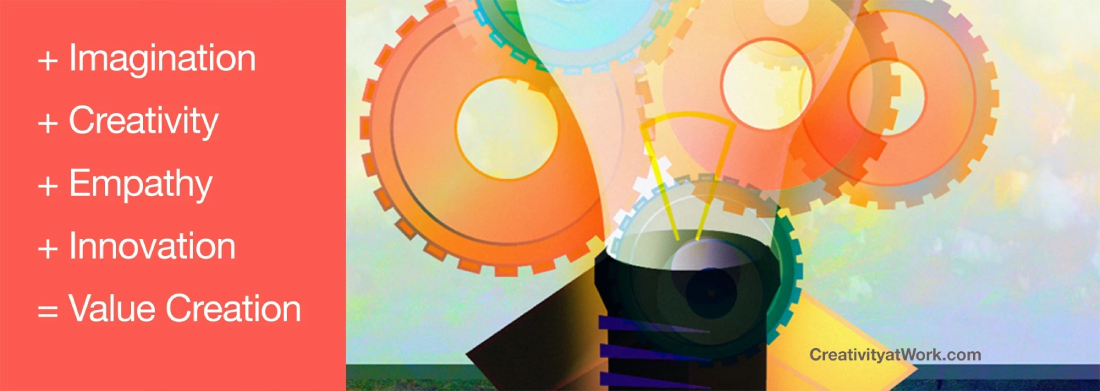
Innovation is the implementation of a new or significantly improved product, service or process that creates value for business, government or society.
Some people say creativity has nothing to do with innovation— that innovation is a discipline, implying that creativity is not. Well, I disagree. Creativity is also a discipline and a crucial part of the innovation equation. There is no innovation without creativity. The key metric in both creativity and innovation is value creation.
Why does creativity matter?
In today’s world, we’re drowning in information and ideas. That’s not the problem. The real challenge is making sense of it all—exercising judgment, seeing what matters, and staying aligned with our values.
That’s why creativity is important. Creativity isn’t just about having ideas. It’s a human capacity for perception, sense-making, and imagination. Creative intelligence is what happens when we develop that capacity intentionally: the ability to synthesize our experience, empathy, and values into action.
It’s how we see patterns others miss, integrate different perspectives, and make wise decisions when things get complicated. It’s what helps a team navigate uncertainty when the playbook doesn’t apply, or as Robert D. Austin and Lee Devin advise in their book Why Managing Innovation is Like Theater:
“Whenever you have no blueprint to tell you in detail what to do, you must work artfully.”
In the age of AI, machines can generate endless possibilities. But generation isn’t the same as discernment. Humans still determine what matters, what to trust, and what to do next.
This capacity—to perceive what matters and act with wisdom—is what keeps humans essential.
Creativity is the most crucial factor for future success
IBM’s 2010 Global CEO Study stated:
The effects of rising complexity calls for CEOs and their teams to lead with bold creativity, connect with customers in imaginative ways and design their operations for speed and flexibility to position their organizations for twenty-first century success.
This insight has aged well. As complexity increases, so does uncertainty—intensifying the need for creativity as a leadership capacity.
The Creativity Gap
- Most leaders and employees say creativity is critical
(for economic growth, innovation, and future success) - Few feel they are fulfilling their creative potential
or have the skills, confidence, or support to do so - Organizations value creativity in principle
but invest unevenly in developing it as a real capability
Recent reports from Adobe, Dell Technologies, IBM, and LinkedIn Learning all point to the same pattern: creativity is widely valued, but rarely cultivated in systematic ways.
That’s why we have a creativity gap.
Can creativity be learned?
The short answer is yes. A study by George Land reveals that we are naturally creative and as we grow up we learn to be uncreative. Creativity is a skill that can be developed and a process that can be managed.
Generative research on creativity
Generative research shows that everyone has creative abilities. The more training you have and the more diverse the training, the greater the potential for creative output.
Research has shown that in creativity quantity equals quality. The longer the list of ideas, the higher the quality of the final solution. Quite often, the highest quality ideas appear at the end of the list.
Behavior is generative; like the surface of a fast flowing river, it is inherently and continuously novel… behavior flows and it never stops changing. Novel behavior is generated continuously, but it is labeled creative only when it has some special value to the community… Generativity is the basic process that drives all the behavior we come to label creative.”
—Robert Epstein PhD, Psychology Today July/Aug 1996
How to be more creative
Creativity begins with a foundation of knowledge, learning a discipline, and mastering a way of thinking. You can learn to be creative by experimenting, exploring, questioning assumptions, using imagination and synthesizing information.
Learning to be creative is akin to learning a sport. It requires practice to develop the right muscles and a supportive environment in which to flourish.
Sir Richard Branson has a mantra that runs through the DNA of Virgin companies. The mantra is A-B-C-D. (Always Be Connecting the Dots).
“Creativeness is the ability to see relationships where none exist.”
— Thomas Disch, author, 334, (1974)
For example you can make comparisons between your company and others outside of your industry. Questions I ask my clients’ teams in advance of our creativity and innovation sessions are: What companies do you most admire and why? What are they doing that you could adopt or adapt to your own company?
Studies by Clayton M. Christensen and his researchers uncovered The Innovators DNA: Your ability to generate innovative ideas is not merely a function of the mind, but also a function of five key behaviours that optimize your brain for discovery:
- Associating: drawing connections between questions, problems, or ideas from unrelated fields
- Questioning: posing queries that challenge common wisdom
- Observing: scrutinizing the behaviour of customers, suppliers, and competitors to identify new ways of doing things
- Networking: meeting people with different ideas and perspectives
- Experimenting: constructing interactive experiences and provoking unorthodox responses to see what insights emerge
Creativity is a practice. The research shows we can all learn to be more creative—and if you practice using these five discovery skills every day, you will develop your creative and innovation capabilities.
Overcoming myths about creativity
One of the most damaging myths about creativity? That only special, talented people are creative—and you have to be born that way. This belief diminishes our confidence in our creative abilities.
But it’s just that: a myth. Researchers at Exeter University examined outstanding performances in the arts, mathematics, and sports to test the widespread belief that to reach high levels of ability a person must possess an innate potential called talent.
The study concludes that excellence is determined by:
- opportunities
- encouragement
- training
- motivation, and
- most of all, practice.
Few showed early signs of promise prior to parental encouragement. No one reached high levels of achievement in their field without devoting thousands of hours of serious training.
Mozart trained for 16 years before he produced an acknowledged masterwork. Moreover many high performers achieve levels of excellence today that match the capabilities of a Mozart, or a Gold Medallist from the turn of the century.”
(The Vancouver Sun, Sept.12/98)
Fostering creativity at work:
So if excellence comes from practice, encouragement, and opportunity rather than innate talent, what does that mean for organizations? HP understood this early on with their ‘Rules of the garage’
These were defined by HP, which in fact started in a garage.
Believe you can change the world.
Work quickly, keep the tools unlocked, work whenever.
Know when to work alone and when to work together.
Share – tools, ideas. Trust your colleagues.
No politics. No bureaucracy. (These are ridiculous in a garage.)
The customer defines a job well done.
Radical ideas are not bad ideas.
Invent different ways of working.
Make a contribution every day. If it doesn’t contribute, it doesn’t leave the garage.
Believe that together we can do anything.
Invent.
—1999 HP Annual Report
Updated Feb 6, 2026
References
Adobe. Creativity in the Workplace (2012).
Dell Technologies. Future of Work research series (2020–present).
IBM Institute for Business Value. CEO and Workforce studies on complexity and leadership (2010–present).
LinkedIn Learning. Workplace Learning Report (2023).