Design thinking can create real competitive advantages
[toc]
When design principles are applied to strategy and innovation, the success rate for innovation dramatically improves. Design-led companies such as Apple, Pepsi, IBM, Nike, Procter & Gamble, and SAP have outperformed the S&P 500 over a 10-year period by an extraordinary 211% according to the 2015 Design Value Index created by the Design Management Institute and Motiv Strategies.1
Great design has that “wow” factor that makes products more desirable and services more appealing to users.
Designing is more than creating products and services; it can be applied to systems, procedures, protocols, and customer experiences.
Design is transforming the way leading companies create value. The focus of innovation has shifted from being engineering-driven to design-driven, from product-centric to customer-centric, and from marketing-focused to user-experience-focused. For an increasing number of CEOs, design thinking is at the core of effective strategy development and organisational change.
Roger Martin, former Dean of Rotman School and author of The Design of Business, asserts, “Design-thinking firms stand apart in their willingness to engage in the task of continuously redesigning their business… to create advances in both innovation and efficiency – the combination that produces the most powerful competitive edge.”2
You can design the way you lead, manage, create and innovate. Moura Quayle, the author of Designed Leadership, says, “Great leaders aspire to manage ‘by design’, with a sense of purpose and foresight. Lessons learned from the world of design when applied to management, can turn leaders into collaborative, creative, deliberate, and accountable visionaries.”3
Despite what critics say, design thinking is not a fad (although if not managed well, it can result in failure). Consulting firms such as McKinsey, Accenture, PwC, and Deloitte have acquired design consultancies: evidence of design’s increasing influence on business. Jeanne M. Liedtka, Strategy Professor at Darden School UVA and design thinking educator, views design thinking as a “social technology which has the potential to do for innovation exactly what TQM did for manufacturing: unleash people’s full creative energies, win their commitment, and radically improve processes”.4
Distinctions Between Design and Design Thinking
Steve Jobs famously said, “Most people make the mistake of thinking design is what it looks like. People think it’s this veneer – that the designers are handed this box and told, ‘Make it look good!’ That’s not what we think design is. It’s not just what it looks like and feels like. Design is how it works.”5
Tim Brown, CEO of IDEO, the design company that popularised the term design thinking, says “Design thinking can be described as a discipline that uses the designer’s sensibility and methods to match people’s needs with what is technologically feasible and what a viable business strategy can convert into customer value and market opportunity.”6
Thinking like a designer brings together what is desirable from a human point of view with what is technologically feasible and economically viable. It also allows people who aren’t trained as designers to use creative tools to address a vast range of challenges.
Design thinking draws on logic, imagination, intuition and systemic reasoning to explore the possibilities of what could be and to create desired outcomes that benefit the end user (the customer).
A design mindset is not problem-focused, it’s solution-focused and action-oriented. It involves both analysis and imagination.
Design thinking is linked to creating an improved future and seeks to build ideas up – unlike critical thinking, which breaks them down. Problem-solving is making something go away. Creating is bringing something into being. Design thinking informs human-centred innovation and begins with developing an understanding of customers’ or users’ unmet or unarticulated needs. The purpose of design, ultimately, in my view, is to improve the quality of life for people and the planet.
What is the driving force behind design thinking?
The biggest driving force is the accelerated rate of change in business and society caused by advances in technology. As companies become more software-driven, and the rate of change increases, so does complexity.
Most companies are optimised to execute and solve a stated problem. Creativity is about finding the problem worth solving. An absence of a scalable creative framework encourages incremental innovation in lieu of disruptive innovation. As companies strive for disruptive innovation, they must find ways to inject and scale creativity across their organisations.
Digital transformation is about the accelerated disruption of business models and requires a mind-set shift from problem solving to problem finding. CEOs need to be visionary leaders: from establishing an internal culture that encourages ideation, creation, and iteration, to building strategic partnerships to create new value propositions.7 – Sam Yen, Chief Design Officer and Dr. Chakib Bouhdary, Digital Transformation Officer, at SAP
Design thinking is our best tool for sense-making, meaning making, simplifying processes, and improving customer experiences. Additionally, design thinking minimises risk, reduces costs, improves speed, and energises employees. Design thinking provides leaders with a framework for addressing complex human-centred challenges and making the best possible decisions concerning:
• Redefining value
• Re-inventing business models
• Shifting markets and behaviours
• Organisational culture change
• Complex societal challenges such as health, education, food, water and climate change
• Problems affecting diverse stakeholders and multiple systems
Design thinking succeeds when it finds ideal solutions based on the real needs of real people. In a recent Harvard Business Review article on the evolution of design thinking, Jon Kolko8 noted,
People need their interactions with technologies and other complex systems to be simple, intuitive, and pleasurable. When done well, human-centred design enhances the user experience at every touch point and fuels the creation of products and services that deeply resonate with customers. Design is empathic, and thus implicitly drives a more thoughtful, human approach to business.
Design thinking informs human-centred innovation. It begins with developing an understanding of customers’ or users’ unmet or unarticulated needs. “The most secure source of new ideas that have true competitive advantage, and hence, higher margins, is customers’ unarticulated needs,” says Jeanne Liedtka (Batten Briefings, 20149), “Customer intimacy – a deep knowledge of customers and their problems – helps to uncover those needs.”
Design thinking minimises the uncertainty and risk of innovation by engaging customers or users through a series of prototypes to learn, test, and refine concepts. Design thinkers rely on customer insights gained from real-world experiments, not just historical data or market research. McKinsey reports the best results come from constantly blending user research –quantitative (such as conjoint analysis) and qualitative (such as ethnographic interviews) with market-analytics.
Creativity at Work Design Innovation Protocol
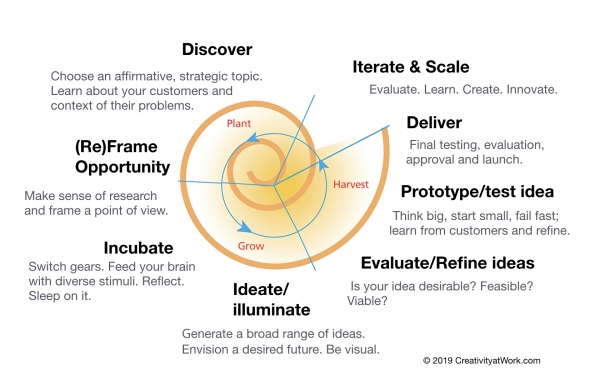
This framework integrates classic creative problem-solving (CPS)2 with art and design methodologies.
Design-Thinking Training, Workshops & Coaching
A Framework for Design Thinking
When you are facing uncertainty, it’s essential to have a structured thinking process to guide your journey. Design thinking offers a structured framework for understanding complexity and pursuing innovation, which I see as being part scientific inquiry and part art. Jeanne Liedtka notes that a new business concept derived from observing customers is actually a hypothesis – a well-informed guess about what customers desire and what they will value. Rapid prototyping provides the means to place small bets on a hypothesis and test it out before investing in expensive resources.
Design thinking is also like jazz. The structure offers a basic melody from which you can improvise, but like any art-form, you need to master the basics first. Kaaren Hanson, head of Design Strategy at Intuit explains, “Anytime you’re trying to change people’s behaviour, you need to start them off with a lot of structure so they don’t have to think. A lot of what we do is habit, and it’s hard to change those habits. So, by having very clear guard rails, we help people to change their habits. And then once they’ve done it 20 or 30 times, then they can start to play jazz as opposed to learning how to play scales.”10
The framework I designed for Creativity at Work (see the diagram above) integrates design thinking principles with classic creative problem-solving (Osborne-Parnes, 1953).11 Creativity is central to design, so I include artistic processes to find aesthetic ways of knowing to stimulate the imagination and assist in sense-making and meaning-making.
The design thinking is an iterative non-linear cycle which involves developing a deep understanding of customers’ or users’ unmet needs within the context of a particular situation, making sense of data and discovering insights, questioning assumptions, exploring different perspectives, reframing problems into opportunities, generating creative ideas, critiquing and choosing ideas, testing through prototyping and experimentation, refining solutions, and finally implementing your innovation.
Implementing design thinking
Design Thinking is a journey of learning and discovery. It’s also a way of being. If you are strategising, you are designing.
- Start at the beginning. Learn how to be a design thinker/doer from a seasoned practitioner.Look for ways to add quality/value to your offerings.
- Build your creative confidence by conducting low-risk experiments, such as designing a meeting with your team. Ask questions which you don’t have answers for.
- Learn how to coach and facilitate for creativity, co-creation and collaboration. This is crucial for creating a safe space for conceptual risk-taking.
- Stay focused on the users’ experience.
- Help teams unlock provocative insights, reframe existing problems, and generate ideas in response to your research.
- Encourage multiple perspectives. Reframe constraints into opportunities and check assumptions.
Stanford’s Design Thinking Model
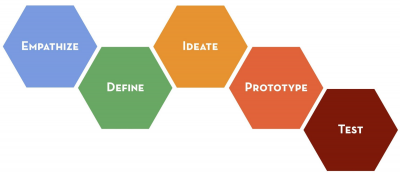
The five practices that enable innovation include: (1) the development of a deep empathic understanding of user needs and context; (2) the formation of heterogeneous teams; (3) dialogue-based conversations; (4) the generation of multiple solutions winnowed through experimentation; and (5) the use of a structured and facilitated process.12
Scaling Design Thinking
SAP, P&G, IBM, and Cisco have integrated design and design thinking throughout the organisation, by creating their own frameworks, educating employees at all levels, hiring professional designers and design researchers, as well as acquiring design companies in order to operate at scale.
Cisco was the first company to launch non-tech HR hackathon in 2016. They used design thinking to “break” and then re-imagine HR solutions for 71,000 global Cisco employees. The “Breakathon” gave birth to 105 new HR solutions covering talent acquisition, new hire on-boarding, learning and development, team development, and leadership.13
Charlie Hill, Chief Technology Officer of IBM Design, said “Our teams had a very engineering-centric culture, but in 2012, everything changed. We wanted to shift that culture towards a focus on users’ outcomes.”14 They made the pivot from standalone, siloed business units to a cloud-first and AI strategy. Karel Vredenburg, head of IBM Design said this enormous transformation wouldn’t have been possible without embedding design thinking into the company culture – and innovating on the methodology to make it uniquely their own.15
When Indra Nooyi was the Chairman and CEO of PepsiCo (2006–2018), she decided the company needed to rethink its innovation process and design experience. “It’s much more than packaging,” Nooyi told the Harvard Business Review. In 2012, she hired Mauro Porcini as Pepsi’s first-ever Chief Design Officer, placing design thinking at the core of business strategy and leadership. “Now, our teams are pushing design through the entire system, from product creation to packaging and labelling, to how a product looks on the shelf, to how consumers interact with it.”
During his tenure as CEO of Steelcase, Jim Hackett pioneered the team-oriented, open workspaces (with the help of anthropologists, sociologists and tech) and transformed the furniture company into a leader of the revolution in the way we work.16 Now, he is tasked with transforming Ford by design, in his role as CEO.
SAP describes its design thinking journey as one that develops from a set of tools, to a methodology, to a mind-set, and until finally becomes a culture.
SAP has identified four critical success factors when implementing design thinking:
- Leadership: Link design thinking initiatives to your strategic goals.Provide direction, resources, and commitment.
- People: Enable champions to lead the change through successful lighthouse projects. Build up an internal design thinking community where best practices are shared.
- Process: Use the generic design thinking framework, but evolve the method and tools so they support your company’s objectives.
- Environment: Develop and create collaborative workspaces for your workforce. Use to co-innovate with your customers and partners.
Design thinking works because it is a collaborative co-creative process grounded in engagement, dialogue, and learning. When you involve customers and/or stakeholders in the process of defining the problem and in developing solutions, you have a much better chance of gaining commitment for change, and getting buy-in for your innovation.
Measuring the impact of Design Thinking
Stanford d.school and Hasso Plattner Institute describe the criteria they use.¹?
- Customer feedback – the feedback from the consumers after using the product or service to determine the level of satisfaction based on their testimonials
- Design thinking activities – the number of design processes and employee participants in it
- “Immediate” results – the number of implemented projects based on design sessions
- Traditional KPIs – units such as financial performance, market success, and revenue outcome of design projects
- Reflective Measurements – questionnaires and surveys completed internally and externally by participants in design processes, including the practitioners, employees, and consumers
- Working culture – the impact of the design inside the organization measured by factors such as motivation, team collaboration, and engagement
ROI of Design Thinking Framework
Liedtka¹² suggests the ROI of Design Thinking is based on three factors
- Practice – Identify the most effective elements actually practised under the rubric of “design thinking.”
- Mechanisms – Assess design’s value for enhancing innovation outcomes
- Impact – Evaluate the overall impact of design in practice
Develop creativity and innovation skills in your workplace
Discover how the interplay of art, design, and technology can help you solve problems and inspire creative solutions desired by your customers.
- Creativity, Innovation, and Leadership Skills Development
- Whole-Brain Creativity Problem Solving
- Design-Thinking Training, Workshops & Coaching
- Creativity and Innovation Training for Teams
Conclusion
In conclusion, the transformative power of design thinking is evident in the success of leading companies like Apple, Pepsi, IBM, Nike, Procter & Gamble, and SAP, which have consistently outperformed market benchmarks. Design thinking is not merely about aesthetics but a holistic approach that combines human-centered innovation with technology and economic viability. This approach is essential in an era of rapid change, where the focus has shifted from engineering-driven to design-driven strategies.
Design thinking offers a structured framework for understanding complexity and pursuing innovation, making it a vital tool for leaders in today’s business landscape. It empowers organizations to redefine value, reinvent business models, and address complex societal challenges while improving the quality of life for both people and the planet. As more companies embrace design thinking, it becomes clear that it is not just a trend but a fundamental shift in how businesses approach innovation, making it a driving force for creating a better future.
This article was updated Oct 27, 2023, An earlier version was published in The European Business Review May – June 2019
References
1. The Design Management Institute DMI Value Index 2015, retrieved from https://www.dmi.org/page/2015DVIandOTW
2. Martin, R. (2009) The Design of Business, Harvard Business School Press.
3. Quayle, M. (2017) Designed Leadership. Columbia University Press
4. Liedtka, J. (2018, Sept-Oct) Why Design Thinking Works, Harvard Business Review
5. Walker, R. (2003, Nov 30) The Guts of a New Machine. New York Times Retrieved http://www.nytimes.com/2003/11/30/magazine/30IPOD.html
6. Brown. T. (2008) Design Thinking Thoughts: Definitions of Design Thinking retrieved from https://designthinking.ideo.com/?p=49
7. SAP (2016) Design Thinking and Digital Transformation. Retrieved from https://www.sap.com/documents/2016/12/4086a5d3-9d7c-00 10-82c7-eda71af511fa.html
8. Kolko, J. (2015, Sep) The Evolution of Design Thinking. Harvard Business Review
9. Liedtka, J.(2014) Batten Briefing: Understanding the Power of Design Thinking. Retrieved from https://issuu.com/batteninstitute/docs/designthinking -121814-issuu
10. Liedtka, J. et al (2013) Solving Problems with Design Thinking: Ten Stories of What Works. Columbia University Press
11. Osborn, A. (1953/2001) Applied Imagination: Principles and Procedures of Creative Problem Solving. Creative Education Foundation Press.
12. Liedtka, J. (2017) Evaluating the Impact of Design Thinking in Action. Vol. 2017. No. 1. Academy of Management
13. Meister, J. Cisco (2016, Mar 10) HR Breakathon: Reimagining The Employee Experience. Forbes. Retrieved https://www.forbes.com/sites/jeannemeister/2016/03/10/the-cisco-hr-breakathon/# 6866c535f5ee
14. Stinson, L. (2016, Jan 21) IBM’s Got a Plan to Bring Design Thinking to Big Business. Wired. Retrieved from https://www.wired.com/2016/01/ibms-got-a-plan-to-bring-design-thinking-to-big -business/
15. Balmaekers, H.(2017, Oct 6) How Innovating On Design Thinking Itself Drives IBM’s Transformation Journey. Techvibes. Retrieved https://techvibes.com/2017/10/06/design-thinking-at-ibm
16. Useem, J. (2019, March) Why Ford Hired a Furniture Maker as CEO. The Atlantic. Retrieved from https://www.theatlantic.com/magazine/archive/2019/03/ford-ceo-jim-hackett-ux-design-thinking/580438/
17. Schmiedgen, J. et al (2016). Measuring the Impact of Design Thinking In H. Plattner et al. (Ed.), Design Thinking Research: Making Design Thinking Foundational (pp. 157-170). Switzerland: Springer International Publishing.• Cross, N. (2007) Designerly Ways of Knowing. Springer.
• Nelson, H.G. and Stolterman, E. (2012) The Design Way, Second Edition Intentional Change in an Unpredictable World. MIT Press.
• Jaw-Madson, K. (2018) Culture Your Culture: Innovating Experiences @Work. Emerald Publishing Limited
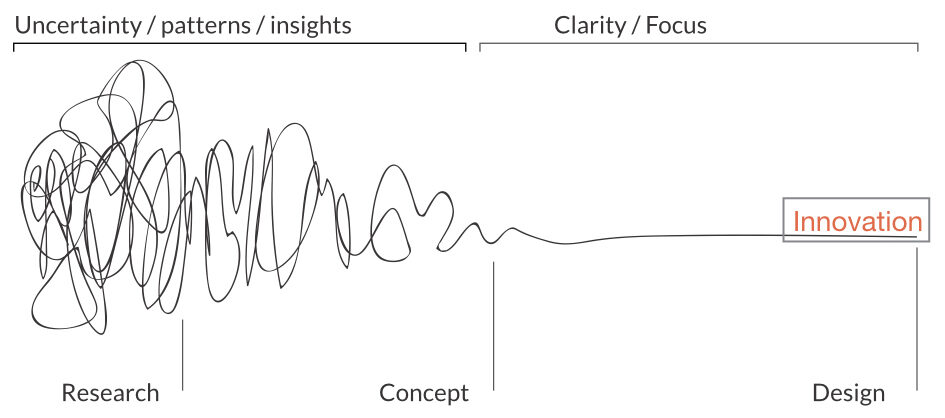
Squiggle Illustration adapted from designer Damien Newman